Posts

The Power of Active Listening: Building Stronger Bonds with Your Child

Image
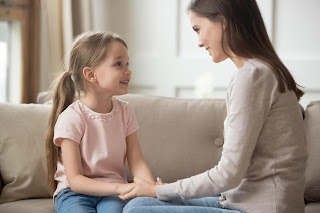
Introduction  Parenting presents its own set of problems and duties. In today's fast-paced and often chaotic environment, it's easy for parents to get caught up in the trap of continuously hustling and multitasking, forgetting to actually connect with their children. However, by actively listening to our children, we can strengthen our bonds, promote their emotional growth, and provide them with the support they require to thrive. In this blog post, we will look at the many advantages of actively listening to your child and provide practical advice on how to include this ability into your parenting routine. How to actively listen: Emotional Validation:  Active listening provides a strong message to your child of love, acceptance, and respect. We support kids to construct a healthy view of their own value when we sincerely listen to their thoughts and feelings, acknowledging and validating their emotions. This emotional validation increases your child's self-esteem and conf...

Parenting coaching

I'm very excited to introduce my new adventure, I've set up a new business to help support other parents.... The Positive Parent As a proud new parent, you’re likely experiencing a range of emotions – excitement, joy, love, and even a bit of anxiety or uncertainty. After all, having a child is a major life change that requires a lot of new skills and responsibilities. While there’s no one-size-fits-all approach to parenting, a parenting coach can help guide you through the ups and downs of raising a child. What is a parenting coach? Parenting coaching is a relatively new field, but it’s a rapidly growing one. As more parents seek guidance and support, the demand for parenting coaches who can provide practical advice, emotional support, and tailored plans is increasing. A parenting coach can help you navigate the day-to-day challenges of raising a child, from dealing with tantrums and meltdowns to encouraging healthy habits and promoting positive self-esteem. At the heart of par...

7 ways to effectively communicate with your child using a positive approach.

Image
As a parent, you have to connect with your child in a good and productive manner. Children who feel understood and respected have a higher chance of thriving and feeling confident. Communication is the foundation of a healthy parent-child connection, and it is critical to have an open and honest discussion. Here are some excellent good ways to communicate with your child: Use positive language When interacting with your child, use positive language. Positive language is a means of expressing yourself that accentuates the good rather than the terrible or negative. The positive language emphasises solutions over issues. When communicating your ideas and feelings to your child, it is critical to use positive language, as this can make your child feel better about themselves. 2. Listen actively Active listening is a necessary component of good communication. Giving your child your entire attention, being present at the moment, and reacting in a way that indicates you comprehend what they a...

Positive Parenting: The Advantages of Raising Your Children Positively

Image
  Parenting is a difficult task. It is not only about feeding, clothing, and sheltering your child; it is also about instilling values, teaching them how to navigate the world, and assisting them in developing into well-adjusted adults. Instead of punishment or coercion, positive parenting emphasises emotional support, nurturing, and positive reinforcement. This parenting style benefits both children and parents. What exactly is positive parenting? Positive parenting refers to a variety of parenting approaches that emphasise positivity, empathy, and communication in order to foster healthy relationships between parents and children. Positive parenting emphasises praising good behaviour, nurturing children's inherent strengths, and guiding them in making positive changes in their lives rather than reprimanding or punishing them for negative behaviours. Positive Parenting Methods Positive parenting techniques differ slightly from traditional methods of parenting. Here are some of the...

4 strategies for creating a better environment for teamwork

Image
  Working as part of a team is something that most people are familiar with. There are times when things get in the way of cohesive working for those of us who are team leaders or some of us may be managers of larger groups. I will discuss four strategies: conflict resolution, having difficult conversations, simple problem-solving plans, and introducing change. Conflict resolution We can't always get along with everyone, so when someone annoys us, we have an emotional reaction that results in behaviour. These emotional or angry reactions are counterproductive and can lead to situations such as relationship breakdown. Anger and resentment can fester beneath the surface for years, causing friction. This can make it difficult to form healthy relationships. This resentment causes arguments at home and can harm spousal relationships. This can impact other associations, such as those with children, parents, or grandparents. This may imply that good ideas and best practices are not shared...

What I learnt at the Children and Childhoods Conference 2022

  I travelled alone for the first time to Ipswich for the Children and Childhoods Conference, hosted by the University of Suffolk. The Open University provided me with a scholarship to attend. This post will provide a synopsis of Professor Helen Lomax's and Professor Alison Clark's keynote addresses for each day. Playful arts-based methods for child-centred research and knowledge exchange during times of global crisis Professor Helen Lomax's presentation, 'Playful arts-based methods for child-centred research and knowledge exchange during times of global crisis,' was discussed. Morgan Jones et al. (2020) suggested that policymaking is limited when children are excluded. When researching this topic, Helen came to the conclusion that using a creative method would allow children to express themselves and that their voices would be plural rather than singular, and that these voices would contain the experiences of those around them. Given the covid-19 pandemic, the ques...

Why is community important to children and young people? What skills and values are important for practitioners as they work together in communities to support children and young people?

 The aim of this work is to outline why community is important to children and young people by discussing the idea of community and how it has evolved over time. It will look at how adults view children and the spaces they occupy, and how this makes children and young people feel. It will discuss social capital and how relationships are intertwined with communities. It also looks at the skills and values that practitioners will need when working in multi-agency settings. When thinking about why community is important to children, we need to first assess what a community means to children and their lives. Community To begin with, the idea of community has changed over time. Changes in the social structure over time have meant that children’s opinions and voices are being sought out in regard to policymaking; however, this has not always been the case. In the past, children were usually "seen but not heard." This has meant that children have specific spaces they are allowed to ...